Be yourself; Everyone else is already taken.
— Oscar Wilde.
This is the first post on my new blog. I’m just getting this new blog going, so stay tuned for more. Subscribe below to get notified when I post new updates.
Be yourself; Everyone else is already taken.
— Oscar Wilde.
This is the first post on my new blog. I’m just getting this new blog going, so stay tuned for more. Subscribe below to get notified when I post new updates.
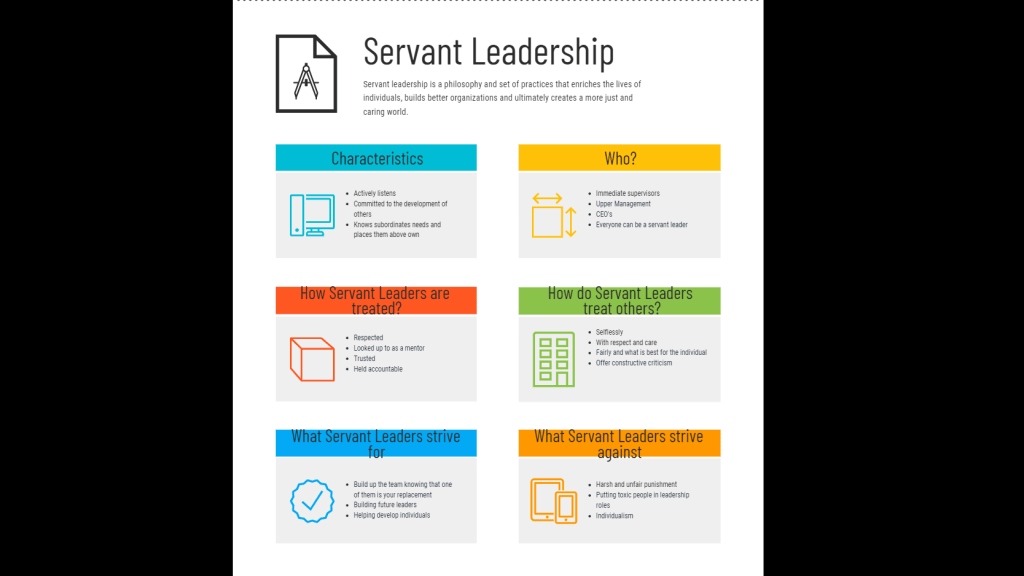
Selfless Service – I believe that the core to a sound leader is selfless service. Selfless service is the act of performing jobs, tasks, or duties strictly for the benefit of other human beings. There is no expectation of reward or recognition when serving others selflessly. All attributes of a good leader stem from the ability to selflessly serve seniors, peers, and subordinates alike.
Loyalty – Without loyalty, there is no team to be a leader of. There is loyalty required of both the leader and the subordinates. The leader must be loyal to the team. The team must be loyal to the leader. Without the reciprocating loyalty, there will be no balance and the team or the leader may feel that they are contributing more than their fair share. Selfless service comes into play here – the leader will ultimately drive the loyalty through selfless service. If the team doesn’t feel both selfless service and loyalty, they will be unable to demonstrate it.
Challenge – Events or tasks that require effort and discipline will help to build both a strong leader and a strong team. If a team feels challenged and in turn, accomplished together, they will build a stronger base of loyalty to each other, the leader, and the organization. When a leader can lead a team through a challenging time or project, he or she may feel confidence in knowing that the team trusted the leadership and guidance they were given. This builds all around loyalty throughout the team.
Personal Development – Through challenges, we are able to develop talents and see new potentials within ourselves and our team members. It is important for a leader to constantly seek out new opportunities for personal development. First of all, this is something that should be done by everyone at all times. There is no reason we shouldn’t all be constantly learning and developing. Also, when a leaders’ subordinates see them taking a self-development course for example, they see that growth is not optional. They see that sitting stagnant is not the way to become the next leader. A leader should also encourage personal development through out the team because he or she is grooming the generation of leaders in the organization.
Humor – Light-hearted laughter is important every day in every position. As a leader, instilling light-hearted laughter and humor helps your subordinates see that you are still human. It is ok to have humor as it helps creativity flow which will help the team find new and innovative ways to solve problems.
As a leader, it is important to remember where you started and to treat your subordinates accordingly. Remember when you were the subordinate and how you felt in different situations. Put individuals in for awards when they are deserving. Discipline individuals when needed. Don’t strive to “make examples” of your subordinates but show them how to treat their peers through your selfless service and loyalty to the team. Show them that their actions will reap appropriate rewards and consequences. Challenge the team to grow both personally and as a group. You are growing the individual that will take your position one day, make sure you do your position and organization justice by creating a better leader than you are.

Selfless Service – I believe that the core to a sound leader is selfless service. Selfless service is the act of performing jobs, tasks, or duties strictly for the benefit of other human beings. There is no expectation of reward or recognition when serving others selflessly. All attributes of a good leader stem from the ability to selflessly serve seniors, peers, and subordinates alike.
Loyalty – Without loyalty, there is no team to be a leader of. There is loyalty required of both the leader and the subordinates. The leader must be loyal to the team. The team must be loyal to the leader. Without the reciprocating loyalty, there will be no balance and the team or the leader may feel that they are contributing more than their fair share. Selfless service comes into play here – the leader will ultimately drive the loyalty through selfless service. If the team doesn’t feel both selfless service and loyalty, they will be unable to demonstrate it.
Challenge – Events or tasks that require effort and discipline will help to build both a strong leader and a strong team. If a team feels challenged and in turn, accomplished together, they will build a stronger base of loyalty to each other, the leader, and the organization. When a leader can lead a team through a challenging time or project, he or she may feel confidence in knowing that the team trusted the leadership and guidance they were given. This builds all around loyalty throughout the team.
Personal Development – Through challenges, we are able to develop talents and see new potentials within ourselves and our team members. It is important for a leader to constantly seek out new opportunities for personal development. First of all, this is something that should be done by everyone at all times. There is no reason we shouldn’t all be constantly learning and developing. Also, when a leaders’ subordinates see them taking a self-development course for example, they see that growth is not optional. They see that sitting stagnant is not the way to become the next leader. A leader should also encourage personal development through out the team because he or she is grooming the generation of leaders in the organization.
Humor – Light-hearted laughter is important every day in every position. As a leader, instilling light-hearted laughter and humor helps your subordinates see that you are still human. It is ok to have humor as it helps creativity flow which will help the team find new and innovative ways to solve problems.
As a leader, it is important to remember where you started and to treat your subordinates accordingly. Remember when you were the subordinate and how you felt in different situations. Put individuals in for awards when they are deserving. Discipline individuals when needed. Don’t strive to “make examples” of your subordinates but show them how to treat their peers through your selfless service and loyalty to the team. Show them that their actions will reap appropriate rewards and consequences. Challenge the team to grow both personally and as a group. You are growing the individual that will take your position one day; make sure you do your position and organization justice by creating a better leader than you are.
For this survey, I again asked two other people who I work with to take the survey in order to get a more specific set of results. The results didn’t vary by much which tells me the answers were similar. I averaged my scores which are listed below.
Get on the Balcony— 19 points – Moderately High -This score represents the degree to which I am able to step back and see the complexities and interrelated dimensions of a situation.
Total Identify the Adaptive Challenge— 14 points – Moderately Low – This score represents the degree to which I recognize adaptive challenges and do not respond to these challenges with technical leadership.
Total Regulate Distress— 21 points – High – This score represents the degree to which I provide a safe environment in which others can tackle difficult problems and to which I am seen as confident and calm in conflict situations.
Total Maintain Disciplined Attention— 19 points – Moderately High – This score represents the degree to which I get others to face challenging issues and not let them avoid difficult problems.
Total Give the Work Back to People— 18 points – Moderately High – This score is the degree to which I empower others to think for themselves and solve their own problems.
Total Protect Leadership Voices From Below—19 points – Moderately High – This score represents the degree to which I am open and accepting of unusual or radical contributions from low-status group members.
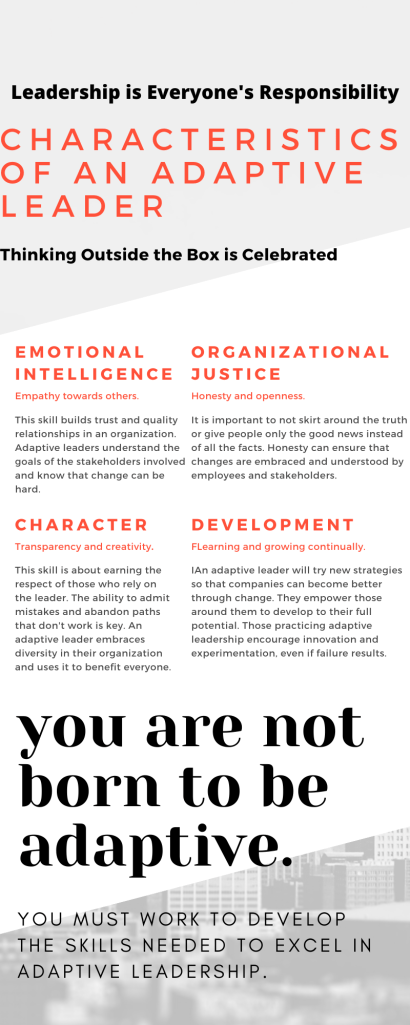
While I wasn’t too surprised by the results, it was good to see where I view m own leadership style in regards to the adaptive style, but also how my peers view me.
I viewed the TED talk that was recommended for this week and I really enjoyed listening to Diane’s story. People weren’t ready for her to bring her culture and essentially her leadership style into the company but it was good for them. It is good to see leaders who are able to lead with a style other than the alpha male leadership style.
I very much identified with Diane’s story. She worked in a pretty male dominated company from what it sounded like, as do I. Sometimes, the males I work with are not ready to listen to my ideas or solutions – it’s not how they would do it or they have “always done it this way.” Amazing things can happen when you listen to everyone, to include the janitor or the window cleaner. I feel that once you gain more responsibility and notoriety, it is very easy to lose sight of the big picture. You become focused on the top number (or whatever it is that your company does.) A great quality of a leader is when they are able to humble themselves and listen to others – being an adaptive leader.
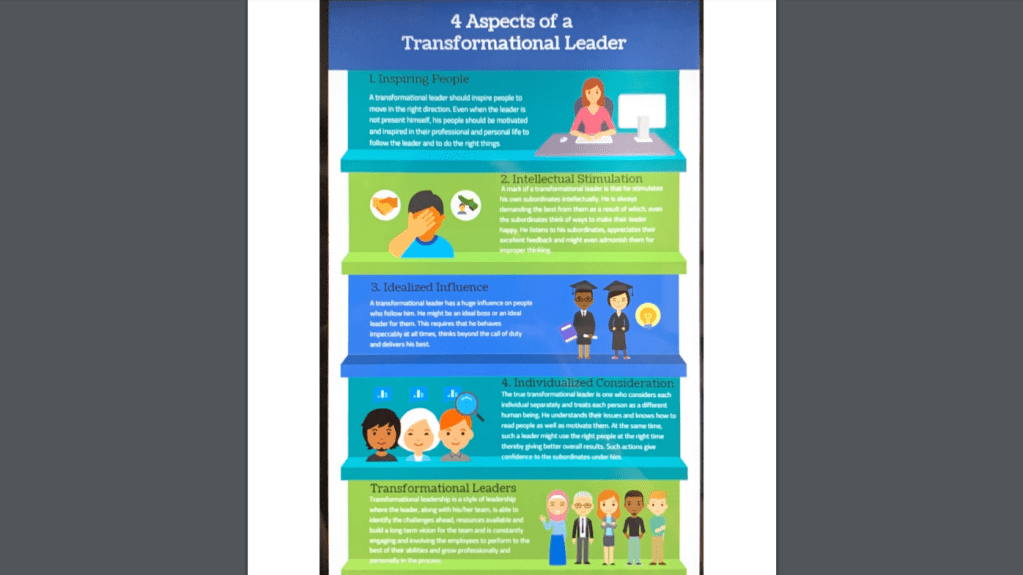
Idealized Influence – 10 (Moderate) – Idealized Influence indicates whether you hold subordinates’ trust, maintain their faith and respect, show dedication to them, appeal to their hopes and dreams, and act as their role model.
Inspirational Motivation – 10 (Moderate) – Inspirational motivation measures the degree to which you provide a vision, use appropriate symbols and images to help others focus on their work, and try to make others feel their work is significant.
Intellectual Stimulation – 9 (Moderate) – Intellectual stimulation shows the degree to which you encourage others to be creative in looking at old problems in new ways, create an environment that is tolerant of seemingly extreme positions, and nurture people to question their own values and beliefs and those of the organization.
Individualized Consideration – 12 (High) – Individualized consideration indicates the degree to which you show interest in others’ well-being, assign projects individually, and pay attention to those who seem less involved in the group.
Contingent Reward – 10 (Moderate) – Contingent reward shows the degree to which you tell others what to do in order to be rewarded, emphasize what you expect from them, and recognize their accomplishments.
Management-by-exception – 11 (Moderate) – Management-by-exception assesses whether you tell others the job requirements, are content with standard performance, and are a believer in “if it ain’t broke, don’t fix it.”
Laissez-faire Leadership – 8 (Moderate) – Laissez-faire measures whether you require little of others, are content to let things ride, and let others do their own thing.
I was not very surprised to see my results, however, it is good to take these surveys to remind yourself of your values. I was pleased to see that my Individualized Consideration was the highest. I like to believe that I care about people and want people to work towards their full potential. I also enjoy caring for people that seem to have few people that do care for them. I also wasn’t to surprised that my lowest score was Laissez-fare Leadership. It is possible that I require a lot of people but it is because those people have the potential for it.
“Even though these theoretical models of Transformational leadership vary in their elements, the collection of behaviors that define the elements of theses various constructs, remain consistent enough that transformational leadership stands as a distinct approach to leadership that can be powerful and effective.” (McManus, Ward, & Perry, 2018,p.339) I appreciate the transformational leadership theory because it challenges everyone – leader and subordinate. If you are working on a team, then teamwork is a necessity. Transformational leadership is just that. Everyone wants to work harder and better because they all push each other.
As you all know, I was at a Senior Leadership Course in Little Rock, Arkansas over the past month. I learned so much that correlates perfectly with this course. Transformational leadership was one of those things that we learned about. If we, as leaders, can take care of and push our subordinates to be better, they will do the same for us. People do amazing things when they know that they are cared for. As you may also know, I currently have awful leadership in my position. I do not feel cared for, I do not feel encouraged or pushed to self develop, and that comes in to play with my work performance. I will very likely not go above and beyond for my leadership when they can’t acknowledge small wins.
“People Building vs. People Using” I took this quote from the video by LeAnne Doose, Chapter 13, Servant Leadership. I am currently at a Senior Leadership Course for the military in Little Rock, Arkansas and I cannot wait to take that quote to my class tomorrow. We have been very focused on how to build up our subordinates because they, hopefully, replace us as leaders one day. People Building vs People Using was a unique way to help me think about servant leadership. It is so simply put. Build people up rather than use people to build yourself up. Another thing I took from that same video was that we must make a conscious choice, as leaders, to choose servant leadership. A great example of servant leadership comes from the greatest servant of all time, Jesus of Nazareth. Despite your religious beliefs, Jesus was the prime example of servant leadership. He ate with, drank with, and served sinners. He is the King of kings, yet had no qualms about washing his disciples’ feet. When I start to catch myself falling away from servant leadership, Jesus is who I look to in that time.
I had two of my leaders fill out the assessment for me. The results were very close, which to me is good because there is not a huge discrepancy in them. The only area that I fell into a moderate was Emotional healing, I tend to exhibit this leadership behavior in an average way. The remaining categories had me at high range, strongly exhibiting this leadership behavior. I was not surprised by the results because I feel that I strive to be a servant leader. I choose a word to focus on every year and this year it is “serve”. I was happy to see that two of the leaders that I respect see me as a servant leader.
Self-assessment is important. When we can take an honest look at ourselves we can reflect on decisions and the results of those decisions. I try to do self-assessments regularly and often find things that I can work on.
We were assigned a self-assessment survey for our Leadership Communication course. I was interested to see if my results would vary depending on the time of day and the type of day that I had. I assumed the results would vary.
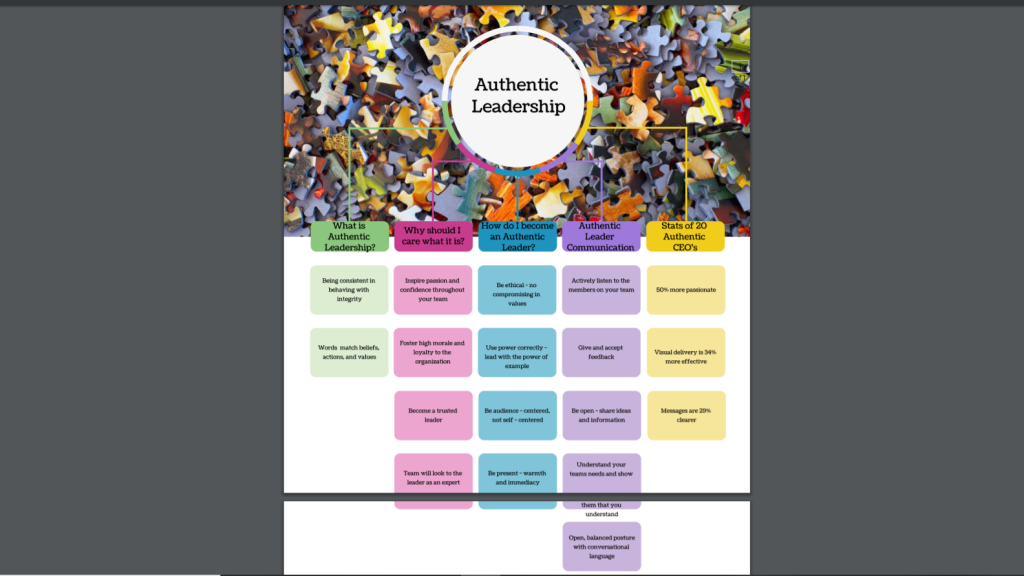
The first time I took the survey was in the afternoon of a busy and hectic day. I scored low in self awareness (12) and high in balanced processing (16). I wasn’t surprised as I felt defeated by that time.
The last time I took the survey was at the end of today. I had a productive day and felt positive in regards to how my day went. I scored high in each area (16) other than relational transparency, which was a 14.
Self awareness could be described as taking time to look at your motives and putting them in check. When you have honest self awareness, you can more effectively lead others. I do believe that without constant self awareness, you will lose sight of your teams’ goals.
Balanced processing would be when you are able to be open minded and appreciate each bit of information. I have learned the importance of this throughout my career. There have been many times where I thought I had the right answer but when I stopped to listen to others, I learned that there are sometimes better right answers.
Internalized moral perspective was one of the more interesting topics to me. It is when you know and follow your morals and values. They are unshakable. I struggled with this growing up, I just wanted to be liked. Now that I am older and have experienced highs and lows, I am able to stay true to myself. I am the one that has to live with me for the rest of my life, so I may as well be happy with who I am.
Relational transparency is taking responsibility for your actions. Reading through this section made me think of a particular leader I currently have who is very much a people pleaser. He does whatever it takes to make people happy to their face, but will blame issues on that same person if it means making himself look good. It is frustrating to work with leaders like this. However, if there is one thing I have learned from working for him it is that I do not want to lead in the way he does.
This is an example post, originally published as part of Blogging University. Enroll in one of our ten programs, and start your blog right.
You’re going to publish a post today. Don’t worry about how your blog looks. Don’t worry if you haven’t given it a name yet, or you’re feeling overwhelmed. Just click the “New Post” button, and tell us why you’re here.
Why do this?
The post can be short or long, a personal intro to your life or a bloggy mission statement, a manifesto for the future or a simple outline of your the types of things you hope to publish.
To help you get started, here are a few questions:
You’re not locked into any of this; one of the wonderful things about blogs is how they constantly evolve as we learn, grow, and interact with one another — but it’s good to know where and why you started, and articulating your goals may just give you a few other post ideas.
Can’t think how to get started? Just write the first thing that pops into your head. Anne Lamott, author of a book on writing we love, says that you need to give yourself permission to write a “crappy first draft”. Anne makes a great point — just start writing, and worry about editing it later.
When you’re ready to publish, give your post three to five tags that describe your blog’s focus — writing, photography, fiction, parenting, food, cars, movies, sports, whatever. These tags will help others who care about your topics find you in the Reader. Make sure one of the tags is “zerotohero,” so other new bloggers can find you, too.

 Leadership Communication